When Dr. Molly Ness explains the science of reading, she’s quick to dispel a common misconception: this isn’t a trendy new approach to teaching literacy.
“The science of reading is a long-standing body of research that shows how the human brain learns to read or acquires literacy,” says Ness, a literacy consultant working with GCDS faculty this year. “This is a body of research about 50 years in the making.”
What is new is the heightened focus on this research, particularly since the COVID-19 pandemic brought literacy instruction into clearer view for families. That increased attention has prompted schools nationwide—including GCDS—to examine their reading instruction practices more closely.
The science of reading draws from psychology, cognition, human development, neuroscience, and pediatrics. These diverse fields converge around a fundamental understanding: reading isn’t an innate skill that children naturally develop on their own. “To become a reader, you have to create neural pathways between parts of the brain meant to serve other functions,” Ness explains. “We have areas of the brain that help with sound and vision and language. Through explicit instruction, these pathways become connected—those connections develop the reading brain.”
Building on Success
Nina Basinet, Head of the Upper Elementary School, has been coordinating the professional development initiative. She explains that GCDS has had high student achievement in reading over the years. Nonetheless, the school regularly evaluates its teaching practices, and recent developments in literacy research prompted a closer look. “We’re constantly looking at our pedagogy and teaching and learning strategies, always looking for improvement and best practice,” Basinet says. While GCDS has maintained a balanced literacy approach that includes spelling and phonics, the school recognized an opportunity to examine current practices, celebrate what it has been doing well, and further deepen its understanding in reading science.
The timing proved fortuitous. When a committee of teachers expressed interest in exploring the science of reading more deeply, they discovered that Ness—a former Fordham University professor with a PhD in Reading Education from the University of Virginia and author of six books for teachers—was already part of the GCDS community as an Upper School parent.
Lower School Reading Support Teacher Abby Arcati says that working with Ness has given teachers opportunities to reflect on their practices. “Professional development encourages continuous improvement and fosters collaboration amongst grade level teams and divisions,” she says. “This, in turn, improves instructional quality and boosts student outcomes. The more teachers think and question their craft, the better it becomes.”
Arcati continues: “Molly comes to us with a wealth of knowledge and expertise related to reading research and best classroom practices. She has raised thought-provoking questions, which have challenged us to review our already successful reading curriculum with a fine-toothed comb, looking for areas where we can enhance the student experience.”
 What’s Happening in Classrooms
The science of reading encompasses more than just phonics and decoding, though those foundational skills remain essential. “Parents often think that phonics and decoding are what reading instruction really should be,” Ness notes. “That is certainly a part of it—those are foundational skills that help kids lift words off the page. But the other huge component is using language to understand what they’re reading: vocabulary, text structure, and background knowledge.”
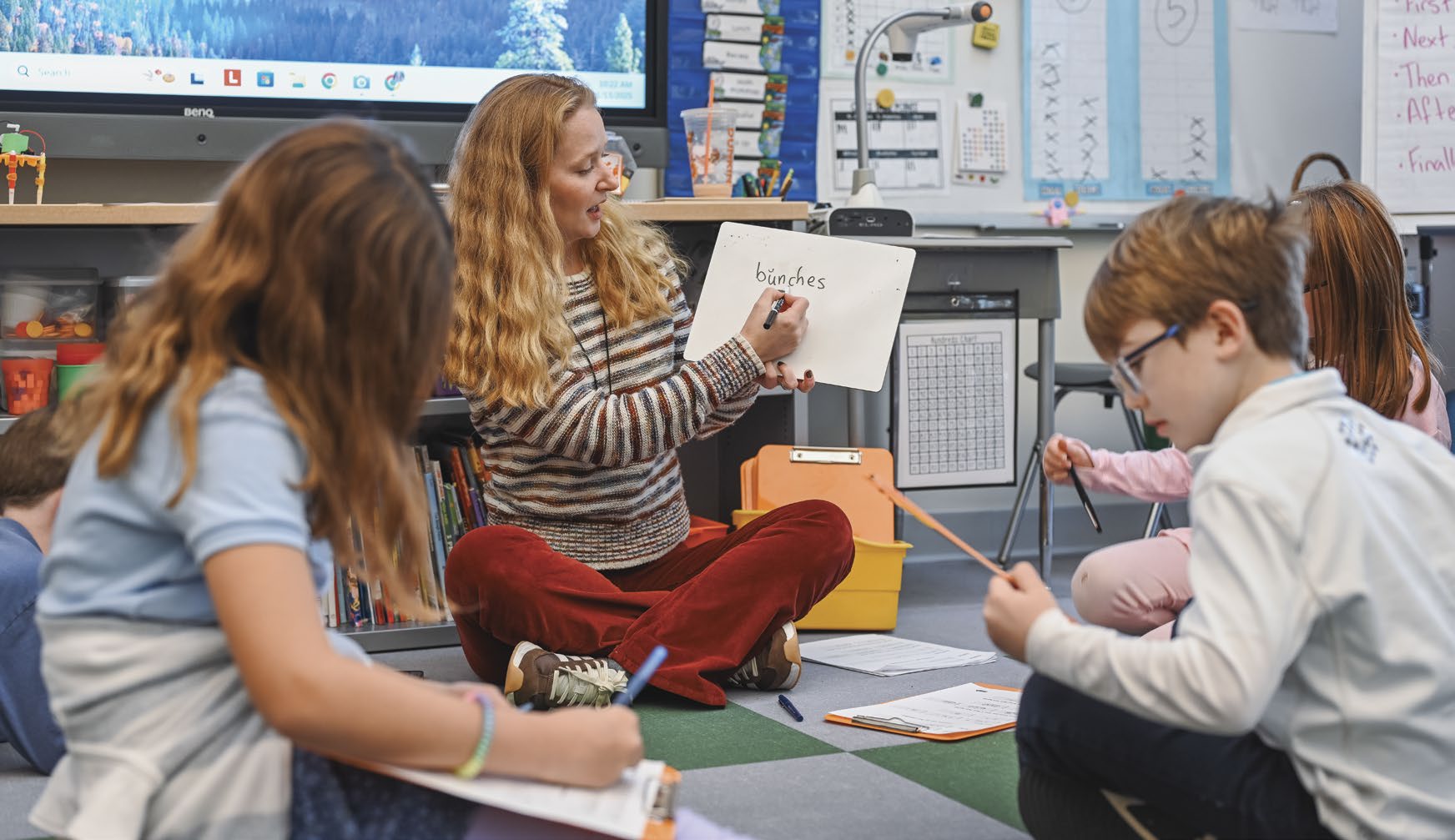
Several shifts are underway in GCDS classrooms. Over the past few years there has been a renewed emphasis on spelling, which serves as far more than just correct word formation.
“If you give me a random 10-year-old and say you’ve got two minutes to find out what you can about where this child is as a reader and writer, a spelling assessment gives me a wealth of information,” Ness says. “I can basically give reliable predictions about that child’s fluency, reading rate, and linguistic knowledge.”
Teachers are also focusing on helping students comprehend more sophisticated texts through explicit vocabulary and background knowledge instruction. Students are learning about morphology—Greek and Latin roots that unlock meaning across multiple words. Understanding how “bio” means life across words like biology, biome, and biosphere helps students access content-area vocabulary in science and other subjects.
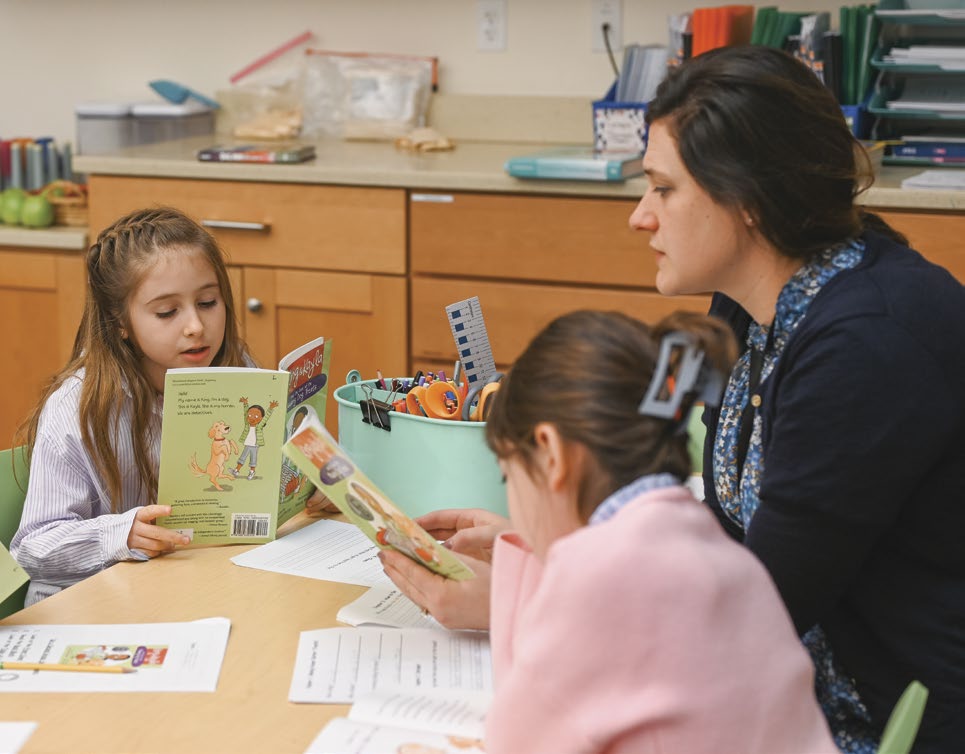 The school has adopted Literably, an assessment tool that provides detailed information about each student’s reading development across multiple components: spelling, fluency, vocabulary, phonics, and comprehension. “We wanted to take an even deeper dive into our readers,” Basinet explains. This assessment helps us understand each student more deeply, in turn helping us to deliver on our promise of helping each child thrive while at GCDS.
Arcati points to concrete changes already taking place. “Already, there has been movement in the elementary grades to incorporate orthographic mapping, targeted vocabulary instruction, and more intentional small-group work,” she says. “Teachers at GCDS are dedicated to implementing new strategies and evidence-based approaches to differentiate learning outcomes for their students, and Molly’s insights have been integral in sparking both meaningful dialogue and action.”
Over the summer, Ness created a graduate-level learning experience for the teaching team. She continues to work with teachers through classroom observations, grade-level meetings, and cross-divisional conversations between the Lower and Upper Elementary schools. “There has been great enthusiasm around it,” Basinet says. “Everyone is deeply invested in the learning.”
Why It Matters
When asked why analytical, deep reading matters in an age of shallow digital engagement, Ness points to the skills that students need as they progress academically and as informed citizens. “When we just read at the shallower level, we’re not getting into those more analytical processing capacities,” she says. Students need to synthesize information across multiple sources, analyze how ideas evolve, and think critically about an author’s purpose.
The research is clear about what works. With explicit, research-based instruction, 95% of children can read at grade level by the end of first grade. “We know what it takes, we know how to do it, and we know when to do it,” Ness says. “The real work is in making sure that’s the standard in every classroom.” At GCDS, that work has been successfully underway.
.jpeg&command_2=resize&height_2=85 "GCDS Juniors Mary Chickering and Kaki Weiksner Win CT Computing Awards")



.jpg&command_2=resize&height_2=85 "Mekai Brown ’27 Commits to USC Trojans and Puts GCDS Football on the National Map")

.jpeg&command_2=resize&height_2=85 "Rowan Introzzi: A Milestone Moment")